
Piper has been dip molding parts for medical device manufacturers for over five decades. We are very good at it, and have enormous production capability.
Medical dip molding is a sub-process of standard dip molding where a mold (or mandrel) is dipped into a polymer and the part forms on the outside of the mandrel. For medical components made from plastisol, (the thermoplastic liquid polymer,) Piper uses stainless steel mandrels because of their stability. These mandrels are ganged up on a handling rack.
The rack is preheated uniformly, then carefully dipped into the plastisol, using a pre-programmed dip profile, for a specified amount of time. The newly formed parts are then withdrawn from the liquid PVC, again using a pre-programmed withdraw profile, post heated, and then cooled. When cool enough the medical components are stripped off the mandrels.

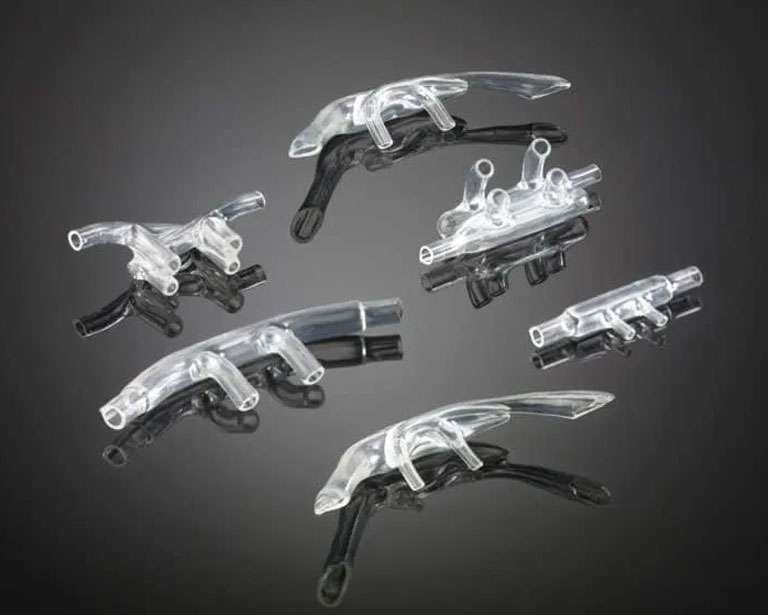
Nasal cannula bodies are Piper’s specialty. We’ve been dipping them since 1972.

Piper’s universal y connectors are typically used in wound drain systems.

Piper has been dip molding enema tips since 1992.

Reinforced tubing is specialty of Piper since the late 1990s
Watch how we bring precision and quality to every dip molded product. Explore our manufacturing process, facility, and commitment to excellence.
Reach out to the knowledgable team here at Piper Plastics to get started on your project! We can help you plan the best course of action to make sure the job gets done right!
Get answers to common questions about our dip molding services and capabilities.
Plastisol dip molding a process whereby a dipping mandrel is dipped into a liquid polymer, typically plastisol, to eventually create a solid form on the mandrel’s external surface.
We work with a variety of materials including PVC (Polyvinyl Chloride), vinyl plastisol, natural rubber, synthetic rubber, and thermoplastic elastomers. Each material offers unique properties such as flexibility, chemical resistance, UV stability, and temperature tolerance. Our team can help you select the best material for your specific application.
Dip molding offers several key advantages: low tooling costs compared to injection molding, ability to create seamless products without parting lines, excellent for small to medium production runs, creates flexible and durable products, and allows for multiple color options and custom textures. It’s ideal for protective coatings, grips, and covers.
Lead times vary depending on project complexity, but typically range from 2-6 weeks for initial tooling and first article samples, and 1-3 weeks for production runs once tooling is approved. Rush services are available for urgent projects. Contact us with your specific requirements for a detailed timeline
We serve a wide range of industries including medical and healthcare, automotive, tools and hardware, consumer products, electronics, sports and recreation, and industrial equipment. Our dip molded products are used in applications ranging from surgical instrument handles to protective caps for automotive parts.
Our minimum order quantities are flexible and depend on the specific product and complexity. We can accommodate prototype runs as small as 100 pieces, while production runs typically start at 500-1,000 pieces. We’re happy to work with you to find a solution that fits your needs and budget.
Yes! We can match Pantone colors and create custom color formulations to meet your exact specifications. We also offer various texture options including smooth, matte, textured grips, and specialty finishes. Our team will work with you to ensure your dip molded products meet your aesthetic and functional requirements.
Absolutely. Our experienced engineering team provides comprehensive design support including material selection, mold design optimization, prototype development, and design for manufacturability (DFM) analysis. We work closely with you from concept to production to ensure your dip molded products meet all specifications and perform as intended.
Our team of experts is ready to help you find the perfect dip molding solution for your project.